
Home › Commercial & Broadcast Rights
Matchday and hospitality revenue
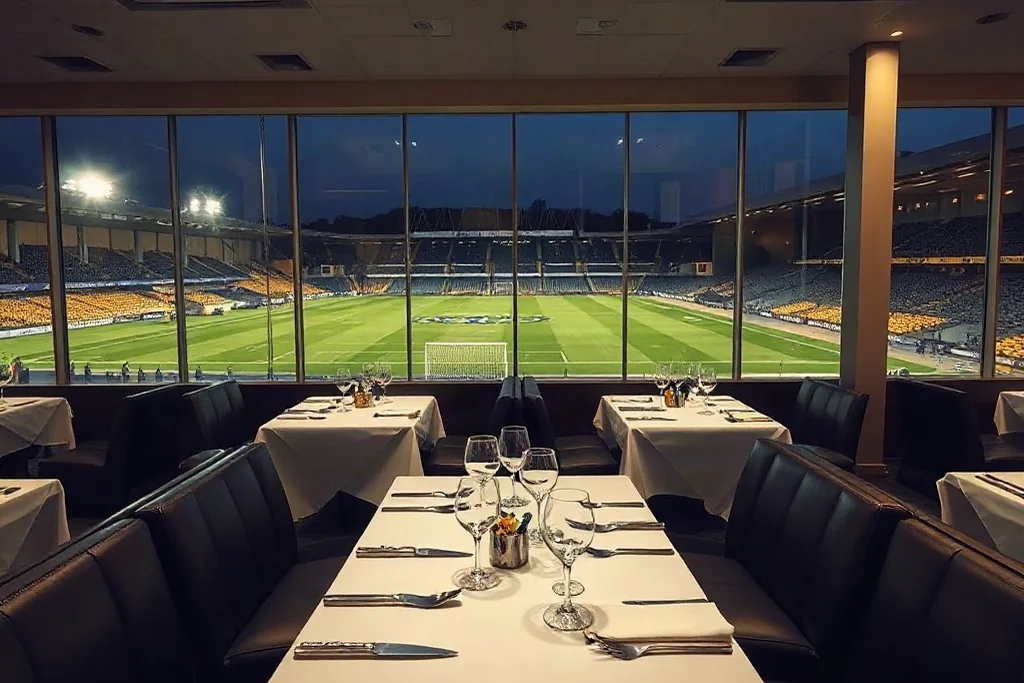
Matchday revenue is the oldest form of football income and still the most visible. It covers tickets, season passes, premium seating, hospitality boxes, food and drink, and the use of the stadium for non-football events. Unlike broadcast money it is generated locally, which makes it a lever that a club can influence directly through its stadium, its pricing and its matchday experience.
The size of the lever depends on the ground. A club with a large modern stadium in a wealthy city can earn several times what a club with an older, smaller ground earns from the same division, which is why stadium investment is one of the few ways a club can permanently change its revenue base.
Ticket revenue and pricing
Ticket income depends on capacity, occupancy and price. Because capacity is fixed in the short term, clubs manage price and segmentation: different categories for different matches, concessions, membership schemes and dynamic pricing for high-demand fixtures. Each of those choices trades revenue against accessibility.
Pricing is politically charged because supporters are the club's most loyal stakeholders and the least able to substitute their consumption. A pricing decision that maximises short-term revenue can weaken the atmosphere and the community relationship on which the club's long-term value partly depends, which is a trade-off finance departments do not always price correctly.
Hospitality and premium seating
Hospitality is the highest-margin element of matchday revenue. A corporate guest pays for a seat, a meal, service and the use of a private space, and the price reflects the business value of entertaining clients rather than the cost of the seat. Clubs therefore invest heavily in lounges, boxes and premium concourses.
Premium revenue is also more cyclical than general ticketing. In a downturn, corporate hospitality budgets are cut quickly, and the effect on club finances can be significant. Clubs with a large hospitality operation are therefore more exposed to the economic cycle than clubs whose revenue is dominated by broadcast money.
The stadium as an asset
A modern stadium is not only a place to watch football. It is a venue for concerts, conferences, exhibitions and community events, and it can generate revenue every day rather than a couple of dozen times a season. Clubs with control of their ground can monetise it; clubs renting a municipal facility usually cannot.
Ownership of the stadium therefore changes the financial profile substantially. A club that owns its ground carries the capital cost and the maintenance, but captures the ancillary revenue. A club that rents avoids the capital cost and gives up most of the upside, which caps how much its revenue base can grow.
How matchday income interacts with financial rules
Matchday revenue counts as qualifying revenue for spending tests, which makes stadium investment a compliance strategy as well as a commercial one. A club that expands its ground or improves its hospitality offer increases the revenue base against which its permitted spending is measured.
The effect is durable in a way that player trading is not. Ticket and hospitality income recurs every season, whereas profit on selling a player is a one-off. Clubs seeking a stable position under revenue-linked rules therefore prioritise stadium projects and commercial growth over transfer-market speculation.
Attendance, atmosphere and the wider dividend
Attendance is not only revenue. A full stadium improves the broadcast product, strengthens the club's brand, and supports sponsorship pricing, so the commercial value of a ticket exceeds its price. Clubs that trade atmosphere for short-term yield can find that the loss shows up elsewhere in the accounts.
This is why many clubs invest in safe standing, family areas, transport links and community programmes that are not directly profitable. The financial case is indirect but real: a stadium that people want to attend is an asset that appreciates, and one that people avoid is a liability that does not.
Components of matchday revenue
- General admission tickets and season passes, priced by match category and seat.
- Premium seating and hospitality boxes sold to businesses and individuals.
- Catering, bars and merchandise sold inside the stadium on matchdays.
- Non-football events such as concerts, conferences and community use.
- Stadium tours, museum visits and other year-round visitor attractions.
Where matchday money comes from
| Revenue line | Driver | Sensitivity |
|---|---|---|
| General admission | Capacity, occupancy and price | Depends on sporting performance |
| Season passes | Loyalty and renewal rates | Fairly stable year to year |
| Hospitality | Corporate budgets and business cycles | Cyclical and quick to fall |
| Catering and retail | Footfall and dwell time | Scales with attendance |
| Non-matchday events | Venue quality and city location | Largely independent of results |
Why the stadium is a financial strategy
Broadcast money is negotiated collectively and player trading is unpredictable, but a stadium is something a club controls. It is the only significant revenue line where a club's own investment produces a direct and lasting increase in the base against which it is allowed to spend.
That is why stadium projects dominate the capital plans of ambitious clubs, and why the terms on which a ground is held matter so much. In a system where permitted spending is tied to revenue, control of the venue is control of the ceiling — and that is a financial fact before it is an architectural one.
Read next
How broadcast rights are pooled and sold
Collective versus individual selling, tender rounds and why pooling exists in the first place.
Distribution models for TV money
The building blocks of a sharing formula: equal shares, merit payments and facility fees.
Sponsorship and naming rights
Shirt, kit and stadium deals — what a sponsor buys, and how the value is judged.