
Fan ownership and supporter trusts
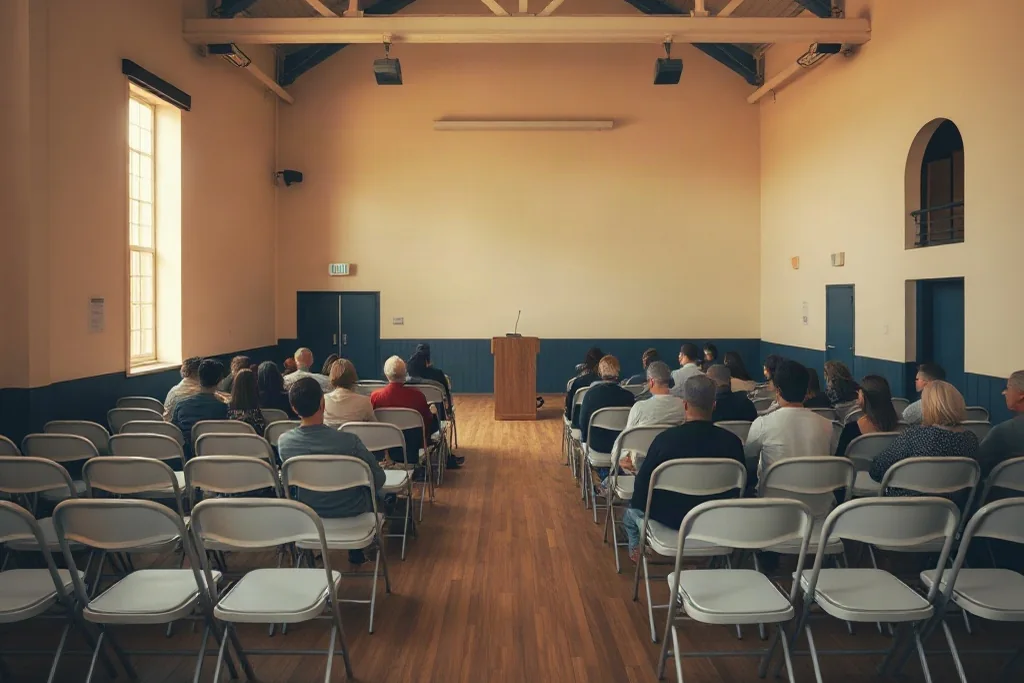
Fan ownership is the other end of the ownership spectrum: the club is held by its supporters, usually through a trust or a members' association, on a one-member-one-vote basis. Control is exercised democratically rather than in proportion to capital, which produces a very different set of priorities from an owner seeking a return.
These clubs are not necessarily small. Some have competed at the highest level, and others have been restructured into community ownership after insolvency. Their finances are usually conservative, their decision making slower, and their survival rate in a crisis often better than that of clubs dependent on a single patron.
How a supporters' trust is built
A trust is a democratic organisation whose members elect a board and vote on major questions. It acquires shares in the club, either through a community share offer or by purchasing an existing stake, and holds them on the members' behalf. The club and the trust remain separate legal entities, linked by an ownership interest.
The model's strength is its legitimacy: decisions taken by members are accepted as the club's decisions, which makes difficult choices such as raising prices or selling a key player more defensible than they would be if imposed by an owner. Its weakness is speed and capital — a trust cannot match the financial firepower of a wealthy investor.
Governance in a democratically owned club
Governance usually includes an elected board, published accounts, member votes on major decisions and a written constitution setting out the club's purpose. Because the constitution encodes the club's identity, matters that elsewhere are owner's discretion become constitutional questions requiring a member vote.
The structure is deliberately resistant to takeover. A member-owned club cannot easily be sold, because the members would have to agree. That protects the club from the ownership instability that affects privately held clubs, at the cost of limiting the capital that can be raised through equity investment.
Where the money comes from
Revenue is generated the same way as at any club — broadcast, matchday, commercial — with the addition of community fundraising, membership subscriptions and sometimes community share offers. Capital projects are typically funded by grants, community bonds, local authority support or a mix of all three.
Because the equity route is limited, these clubs rely on debt and on their own cash flow, which makes them careful. A conservative balance sheet is a survival strategy in a league where relegation can remove a large share of revenue overnight, and it is one reason such clubs have tended to weather financial shocks comparatively well.
Golden shares and identity protections
Where a trust does not hold a controlling stake, it may hold a golden share — a special right that gives supporters a veto over specific decisions. Common protected matters include the club's name, colours, badge, home stadium and relocation. The golden share protects identity without requiring control of the balance sheet.
The mechanism is used to reconcile outside investment with supporter interests, allowing a club to accept capital while preserving its cultural continuity. Its effectiveness depends entirely on how narrowly the veto is drawn: a golden share limited to a handful of defined decisions is durable, while one that implies influence over general policy tends to be resisted by investors.
Advantages and limits
The advantages are commitment, transparency, long-termism and legitimacy. Supporters do not sell out, do not lose interest and do not relocate the club. Decisions are taken in the open, and short-term financial discipline is easier to justify when the decision makers are the people who will live with the consequences.
The limits are capital, expertise and speed. Member-owned clubs rarely win auctions for elite players, may struggle to finance stadium projects, and can be slow to act when a commercial opportunity requires a quick decision. Whether that is a price worth paying is, again, a question about what a club is for.
Features typical of a supporter-owned club
- One-member-one-vote governance with an elected board.
- A constitution that fixes the club's purpose and identity.
- Community share offers and membership subscriptions as equity routes.
- Open publication of accounts and decisions to members.
- Possible golden share protections over name, badge, colours and stadium.
Ownership models compared
| Model | Main strength | Main constraint |
|---|---|---|
| Supporter trust | Legitimacy and stability | Limited access to equity capital |
| Member club with investors | Capital plus identity protection | Slow, negotiated decision making |
| Single private owner | Speed and decisive funding | Dependence on one person's fortunes |
| Financial fund | Professional management and capital | Exit horizon shapes priorities |
| State-linked owner | Deep, patient resources | Political and regulatory scrutiny |
Why fan ownership matters beyond the clubs that use it
Even where supporters do not own their club, fan ownership provides the benchmark against which other models are judged. It demonstrates that a club can be run transparently and survive, which raises the expectation that other owners should disclose more, consult on identity questions and plan for the long term.
It also supplies the crisis tool. When a club fails, a supporters' trust is often the only credible buyer willing to take it on, and the only one with an interest in preserving its local identity. That role, more than any competitive argument, is why supporter ownership continues to expand even in leagues dominated by private capital.
Read next
The 50+1 rule and member ownership
How member control works, why it limits outside investors and how exceptions have been handled.
Multi-club ownership groups explained
How one owner can hold several clubs, what the rules permit and where conflicts of interest appear.
State-linked and sovereign wealth ownership
What changes when a club’s owner is a state fund or a state-linked entity, and how regulators frame it.